How to see the space station from your own garden.
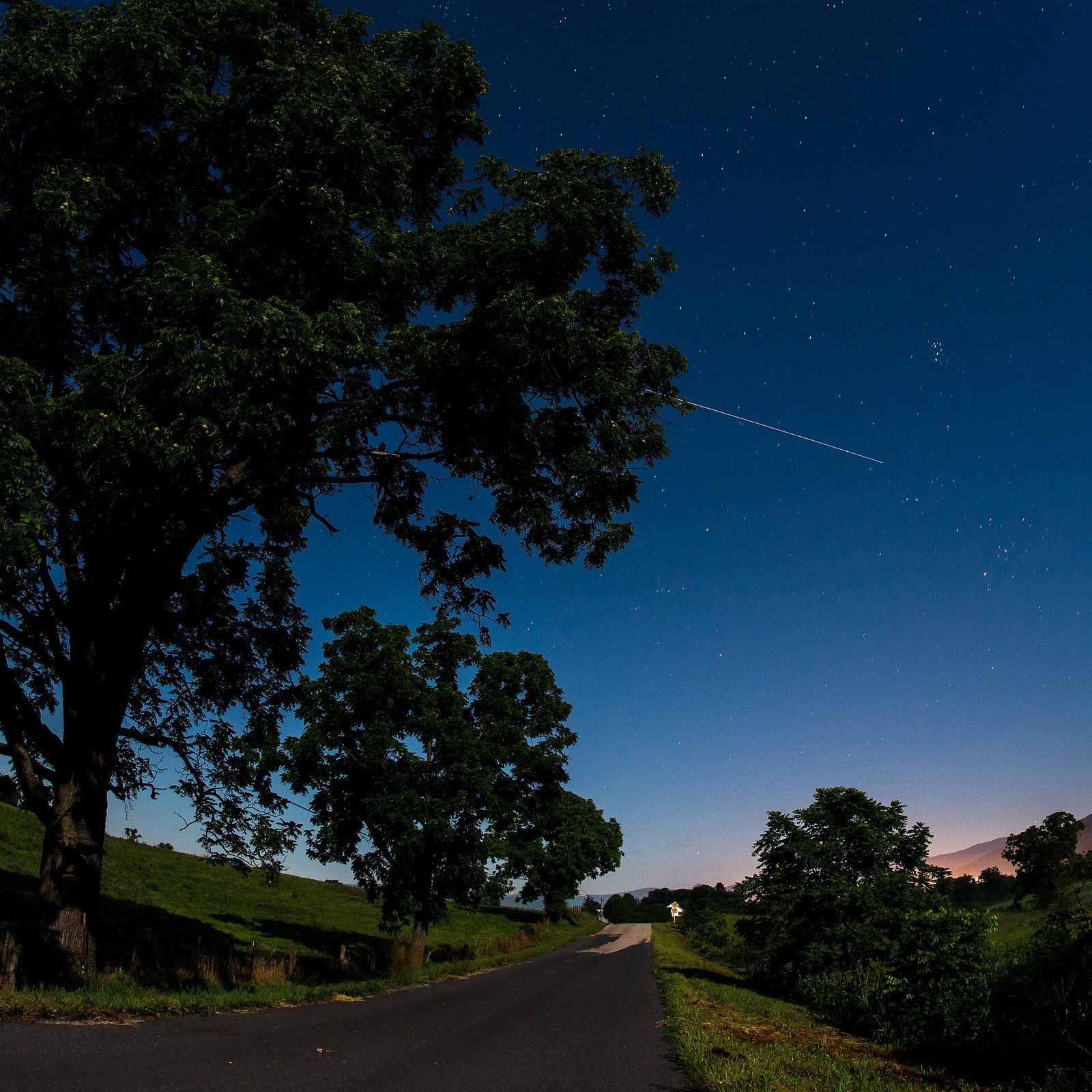
When and where to look for the International Space Station, what a pass looks like, how to read pass predictions, and why some evenings have no passes at all.
The International Space Station is the easiest spacecraft in the sky to see. It needs no telescope, it is bright enough to spot from a city center, and it crosses over most inhabited places several times a week. Yet many people have never knowingly seen it, because a pass lasts only a few minutes and happens at specific times. With a little planning you can catch one on the first try.
What you are looking for
NASA describes the station as looking like an airplane or a very bright star moving across the sky, except that it has no flashing lights and does not change direction. It moves much faster than an aircraft: about 28,000 km/h, compared with roughly 965 km/h for an airliner. Because it is around 400 km up, though, it appears to glide smoothly and steadily rather than streak.
The station itself makes no light. What you see is sunlight reflecting off its large solar arrays and modules. That simple fact explains almost everything about when you can see it.
Why passes happen near dawn and dusk
For a pass to be visible, two things have to be true at the same moment. The sky where you are must be dark enough to see the station against it, and the station, high above you, must still be in sunlight.
That combination happens in the hours after sunset and before sunrise. NASA's Spot the Station service notes that all sightings occur within a few hours before or after sunrise or sunset. In the middle of the night, the station usually passes through Earth's shadow and becomes invisible, even if it is directly overhead. Around midsummer at higher latitudes, the station can stay sunlit all night, which can produce several visible passes in one evening.
This is also why a pass can end suddenly. As the station moves into Earth's shadow, it turns orange, fades and disappears in mid-sky, sometimes well before reaching the horizon.
Reading a pass prediction
Pass predictions, whether from NASA's app or the Your sky tool in Orbit Atlas, give a few key numbers.
- Start time: when the station rises into view, in your local time zone.
- Appears: the direction and height above the horizon where it first becomes visible.
- Maximum height: the highest point of the pass, in degrees. The horizon is 0 degrees and directly overhead is 90 degrees.
- Disappears: where it leaves your view, either by setting or by entering Earth's shadow.
- Duration: how long it is above your horizon.
The maximum height matters most. A pass that peaks at 10 or 15 degrees stays low, where trees, buildings and haze can hide it. A pass that climbs above about 40 degrees is much easier to see and noticeably brighter, because the station is closer to you. For a first attempt, choose a pass with a high maximum height.
In Orbit Atlas, the Your sky tool lists passes higher than 10 degrees and indicates when the lighting is favorable: the station is sunlit while your own Sun is more than 6 degrees below the horizon. A favorable pass is an opportunity, not a guarantee. Clouds, terrain and very low passes can still get in the way.
Why there are weeks with no evening passes
The station's orbit is tilted 51.6 degrees to the equator, and it makes about 16 orbits a day. Its path over the ground shifts westward with each orbit as Earth turns beneath it. Over a cycle of several weeks, the timing of passes over any one place drifts from the morning sky to the evening sky and back again. There will be stretches when all the passes are before dawn, or happen in daylight, and then a run of good evenings.
The tilt also sets a geographic limit. As NASA explains, the station never goes further north or south than 51.6 degrees latitude, so places beyond that, such as much of Scandinavia, Scotland's far north and Alaska, never have it directly overhead. They still see passes, but lower in the sky. Our guide to why the station flies at 51.6 degrees explains where that number comes from.
How to watch your first pass
- Find a pass with a maximum height of at least 40 degrees and a time that suits you.
- Go outside five minutes early and let your eyes adjust. Use a compass or a known landmark to find the direction where the pass begins.
- Look low in that direction at the start time. The station rises as a faint point and brightens as it climbs.
- Follow it across the sky. It will not blink, and it will travel smoothly from one horizon toward the other.
- Watch for the fade. If the pass ends in Earth's shadow, you will see it dim and vanish.
Binoculars are not needed and can make it harder to keep the station in view. If you want a photograph, put a camera or phone on a tripod and take a long exposure of several seconds as it passes. The station will appear as a bright line, like the photograph at the top of this page.
Why predictions are refreshed
The station is low enough to feel a trace of Earth's atmosphere. NASA's Spot the Station notes that this thin drag causes the projected trajectory to accumulate small errors, so flight controllers update the trajectory roughly three times a week. The station is also boosted to a higher orbit from time to time. Both mean that predictions made weeks ahead can be off by minutes.
Orbit Atlas uses a dated snapshot of public orbital elements and shows how old each set is. For a time-critical observation, check a fresh prediction from NASA on the day. Our guide to two-line element sets explains how these orbit descriptions work and why they age.
A station with a limited future
The station has been continuously crewed since 2000. NASA has committed to operating it through 2030, after which it will be guided down to a controlled re-entry over a remote part of the ocean. Our guide to where old spacecraft go describes how that will work. Until then, it remains one of the most rewarding things you can see in the night sky with your own eyes.
Sources
- NASA: Spot the Station
- NASA: International Space Station transition plan FAQs
- CelesTrak: FAQs, two-line element set format
Original guide · Published 11 November 2026.