What happens when a spacecraft comes home for the last time.
How satellites and rocket stages leave orbit, the difference between controlled and uncontrolled re-entry, why remote ocean areas like Point Nemo are used, and how the International Space Station will end its mission.
Nothing stays in low Earth orbit forever. Even a few hundred kilometers up, there is a trace of atmosphere that slowly saps a satellite's speed. Without regular boosts, its orbit sinks lower and lower until it plunges into the thicker air below and burns up. For small satellites, that is the end of the story. For larger objects, where pieces may survive to the ground, the ending has to be planned carefully.
This guide follows spacecraft through the last stage of their lives, and explains why one remote patch of the Pacific Ocean has become the final destination for some of the largest.
Natural decay
The rate at which an orbit decays depends on altitude, the object's size and mass, and the activity of the Sun. Solar activity heats and expands the upper atmosphere, raising drag on low satellites. ESA's 2025 space environment report notes that the recent peak in the solar cycle has increased drag and accelerated re-entries.
Height makes a dramatic difference. NASA estimates that the International Space Station, at about 415 km, would re-enter within roughly one to two years from drag alone if it were never boosted. Satellites several hundred kilometers higher can stay up for decades or centuries.
You can see the effect of drag in Orbit Atlas by comparing the element ages and altitudes of low satellites over time, and our guide to two-line element sets explains why low orbits are harder to predict.
Many re-entries every day
Re-entry is now a routine event. ESA reports that intact satellites or rocket bodies are re-entering Earth's atmosphere on average more than three times a day. Most are small or designed to burn up completely. Rocket bodies are increasingly brought down deliberately: ESA notes that in 2024, controlled re-entries of launcher stages outnumbered uncontrolled ones for the first time.
Controlled versus uncontrolled re-entry
In an uncontrolled re-entry, an object falls when drag finally wins, and the exact time and place cannot be predicted far in advance. That is acceptable only when the risk to people is very small, for example when the object is small or will break up into small pieces.
In a controlled re-entry, the spacecraft uses its own engines, or a vehicle attached to it, to make a final braking burn. That steepens its descent so it enters the atmosphere at a planned time over a planned area, with any surviving debris falling into an empty stretch of ocean.
NASA explains that the US Government requires re-entering spacecraft to keep the risk to the public below 1 in 10,000. A large spacecraft that cannot meet that requirement has to make a controlled re-entry.
Point Nemo: the most remote place on Earth
When engineers want to drop debris as far from people as possible, they often look to the South Pacific, around a location known as Point Nemo. It is the oceanic point furthest from any land, roughly 2,688 km from the nearest coastline. The area around it has been used as the target for many controlled re-entries, including Russia's Mir space station in 2001, and is sometimes called the spacecraft cemetery.
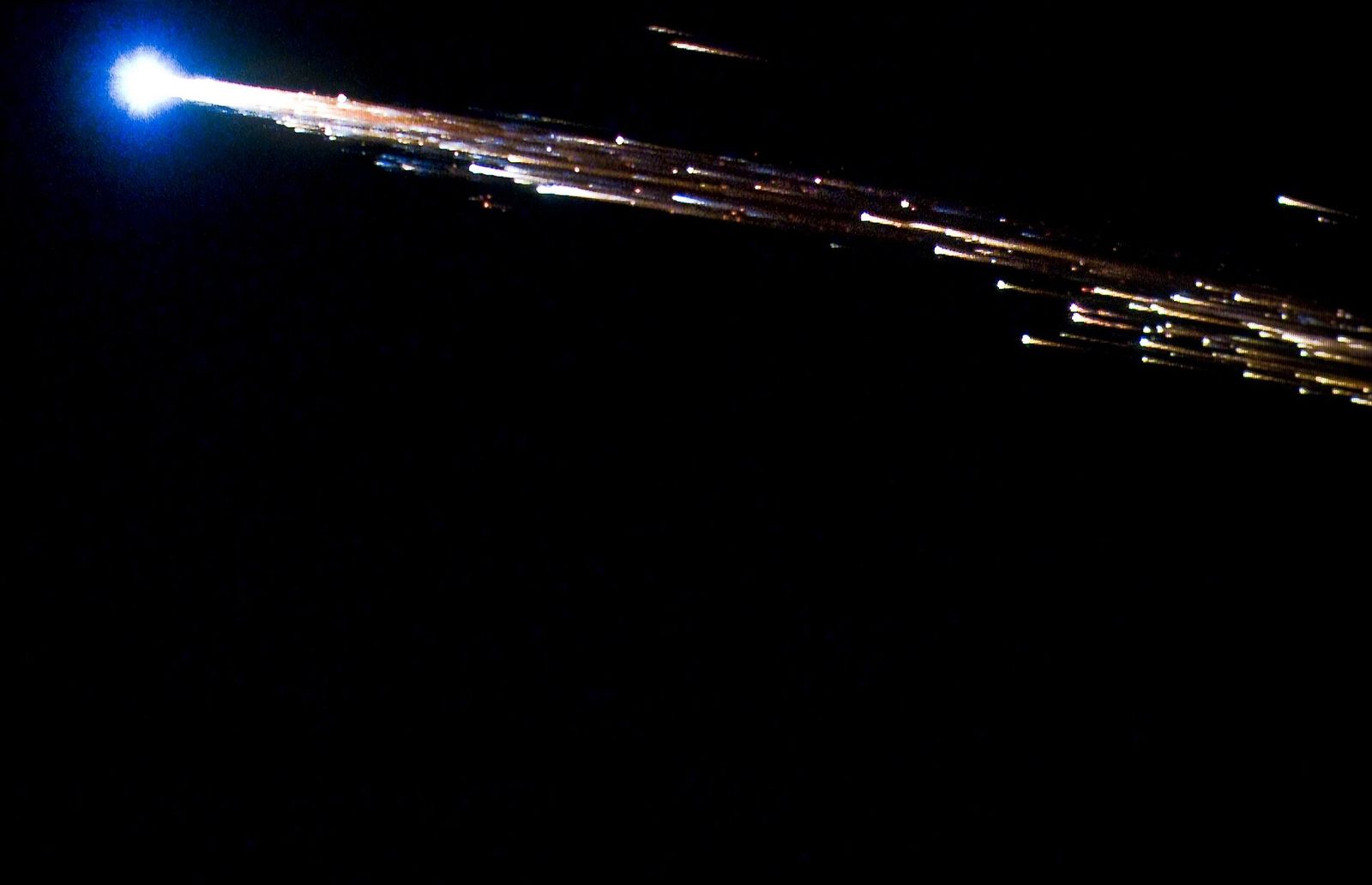
The photograph at the top of this page shows ESA's first Automated Transfer Vehicle, Jules Verne, a cargo ship that had resupplied the International Space Station. It made a planned re-entry over an uninhabited area of the Pacific on 29 September 2008. Researchers aboard aircraft photographed it breaking apart, which helped improve understanding of how large spacecraft fragment.
The end of the International Space Station
The space station is the largest structure ever built in space, with a mass of more than 430,000 kg. NASA has committed to operating it through 2030. After that, it will be brought down in a controlled re-entry.
NASA's plan, set out in its transition FAQs, is to let drag lower the station's orbit, then use propulsion to line up its final ground track over an uninhabited ocean area. Once the last crew has returned to Earth, a large final burn will send it into the atmosphere. NASA has selected SpaceX to build a US Deorbit Vehicle for that final maneuver.
NASA expects the station to break up in stages: solar arrays and radiators first, then modules and the truss separating, and finally individual modules fragmenting. Most of the hardware should burn up or vaporize, but denser parts, such as truss sections, are expected to survive and fall into the target area of ocean.
NASA also considered alternatives, including boosting the station to a higher orbit. It found that the station would need about 57 m/s of velocity change for a controlled deorbit, compared with 120 to 140 m/s to reach an orbit lasting about 100 years, and that the risk of a damaging debris impact would be much higher at those altitudes.
Higher orbits: the graveyard
For satellites in geostationary orbit, about 35,786 km above the equator, coming back down would take far too much fuel. Instead, at the end of their lives they are usually boosted a few hundred kilometers higher into a disposal orbit, often called a graveyard orbit. There they remain, out of the way of the valuable geostationary belt, essentially forever.
Why it matters
Getting old spacecraft out of busy orbits is one of the most effective ways to slow the growth of space debris. Our guide to space debris explains the wider problem, and why GPS flies 20,000 km up describes the main orbital neighborhoods and what each is used for.
Sources
- NASA: International Space Station transition plan FAQs
- ESA: Space Environment Report 2025
- Space.com: Point Nemo, where the International Space Station will end its life
Original guide · Published 11 November 2026.