The crowded orbits nobody can see.
What space debris is, how much of it is tracked, how a paint fleck can crack a spacecraft window, what the Kessler syndrome means, and how agencies are trying to keep useful orbits open.
Space looks empty in photographs, but the orbits closest to Earth are increasingly busy. Alongside the working satellites that provide navigation, weather forecasts and communications, there are dead satellites, spent rocket stages and many thousands of fragments from explosions and collisions. All of them travel at orbital speed. Space debris is one of the main reasons satellite operators now plan constantly around the risk of collision.
When you open Orbit Atlas, you see a selection of catalogued objects. This guide explains what lies behind those dots, and the much larger population that is too small to show.
What counts as debris
ESA defines space debris as all non-functional, human-made objects, including spacecraft that no longer work or fragments of them, in orbit or re-entering the atmosphere. That covers:
- Old satellites that have reached the end of their missions but remain in orbit.
- Rocket bodies, the upper stages left behind after placing satellites in orbit.
- Mission-related objects, such as covers, adapters and bolts released during launch and deployment.
- Fragments from explosions of leftover fuel or batteries, from collisions, and from deliberate destruction.
- Tiny particles, including flecks of paint and solid rocket exhaust.
How much is up there
ESA's Space Environment Report 2025, based on data to the end of 2024, gives these figures:
- About 40,000 objects are tracked by space surveillance networks.
- About 11,000 of those are active satellites.
- More than 1.2 million objects larger than 1 cm are estimated to be in orbit, with over 50,000 larger than 10 cm.
Only the larger objects can be tracked. The great majority of dangerous pieces are too small to follow individually, so spacecraft have to be designed and shielded with that unseen population in mind.
Why something so small is dangerous
In low Earth orbit, objects travel at around 7 to 8 km per second. Two objects in different orbits can meet at a combined speed of several kilometers per second, far faster than a rifle bullet. At those speeds, kinetic energy is enormous even for small masses.
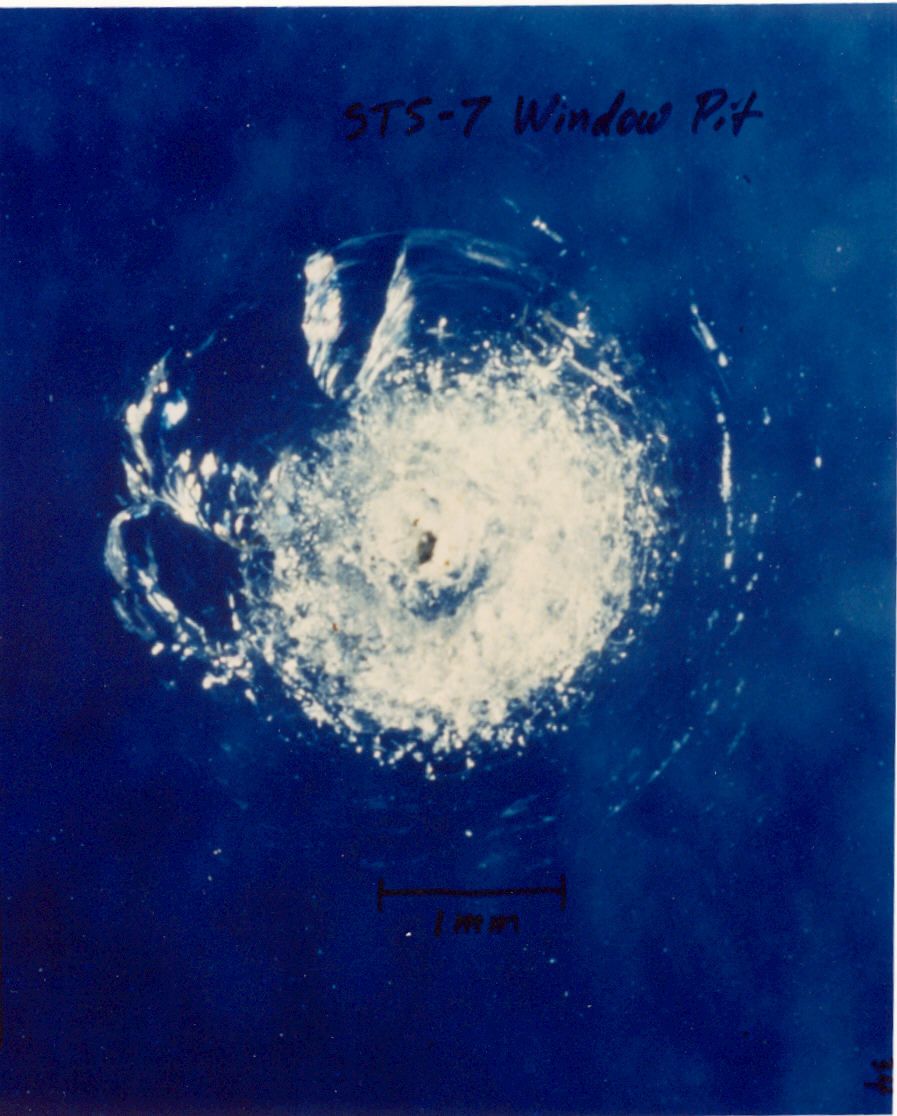
The photograph above shows a small pit in a window of the Space Shuttle Challenger after a collision with a fleck of paint during the STS-7 mission in 1983. ESA notes that objects larger than 1 cm can cause catastrophic damage to a satellite. Larger objects can destroy a spacecraft outright and create a new cloud of fragments.
The events that changed the picture
Two events are often cited because each added a large amount of long-lived debris.
A deliberate test in 2007
On 11 January 2007, China destroyed its own defunct Fengyun-1C weather satellite with a ground-launched missile. The test created thousands of trackable fragments at a busy altitude, many of which will remain in orbit for decades.
The first accidental collision of two satellites in 2009
On 10 February 2009, the active communications satellite Iridium 33 and the defunct Russian satellite Cosmos 2251 collided at high speed over Siberia. Both were destroyed, producing large clouds of debris. It was the first known accidental collision between two intact satellites.
ESA reports that 2024 also saw several major fragmentation events, which together added at least 3,000 tracked objects in a single year.
The Kessler syndrome
In 1978, NASA scientists Donald Kessler and Burton Cour-Palais described a possible future in which collisions between objects in orbit create fragments that cause further collisions, building on each other. This cascade is now known as the Kessler syndrome.
ESA's 2025 report states that there is a scientific consensus that, even without any further launches, the number of debris objects would keep growing, because fragmentation events add new objects faster than old ones re-enter the atmosphere. Left unchecked, the cascade could make certain orbits unsafe and unusable.
How collisions are avoided today
Operators receive warnings when another tracked object is predicted to pass too close, and many satellites carry thrusters to step out of the way. ESA notes that the number of events triggering collision avoidance procedures goes up each year, especially in low orbit. The International Space Station itself regularly performs debris avoidance maneuvers. NASA has noted that the risk of a damaging impact on the station would rise sharply at higher altitudes.
Good tracking data is essential to all of this. Our guide to two-line element sets explains how orbit data is shared and why it ages.
What is being done
Agencies and operators are taking several approaches:
- Remove satellites at end of life. The long-standing guideline was to bring low satellites down within 25 years of the end of their missions. ESA has adopted a stricter five-year standard for its own missions, and its 2025 report notes that about 80 percent of rocket bodies in low orbit already meet it.
- Passivate spacecraft. Venting leftover fuel and discharging batteries at end of life reduces the chance of later explosions.
- Design for demise. Using materials and structures that burn up fully on re-entry reduces risk on the ground.
- Active debris removal. Missions such as ESA's planned ClearSpace-1 aim to capture and deorbit existing debris.
- Zero debris commitments. ESA's Zero Debris approach aims to significantly limit the production of debris by its missions by 2030.
Our guide to where satellites re-enter explains what happens when objects come back down, and satellite constellations and astronomy covers the rapid growth in the number of satellites.
Sources
- ESA: Space Environment Report 2025
- NASA: International Space Station transition plan FAQs
- NASA Orbital Debris Program Office
Original guide · Published 11 November 2026.