When the sky fills with satellites.
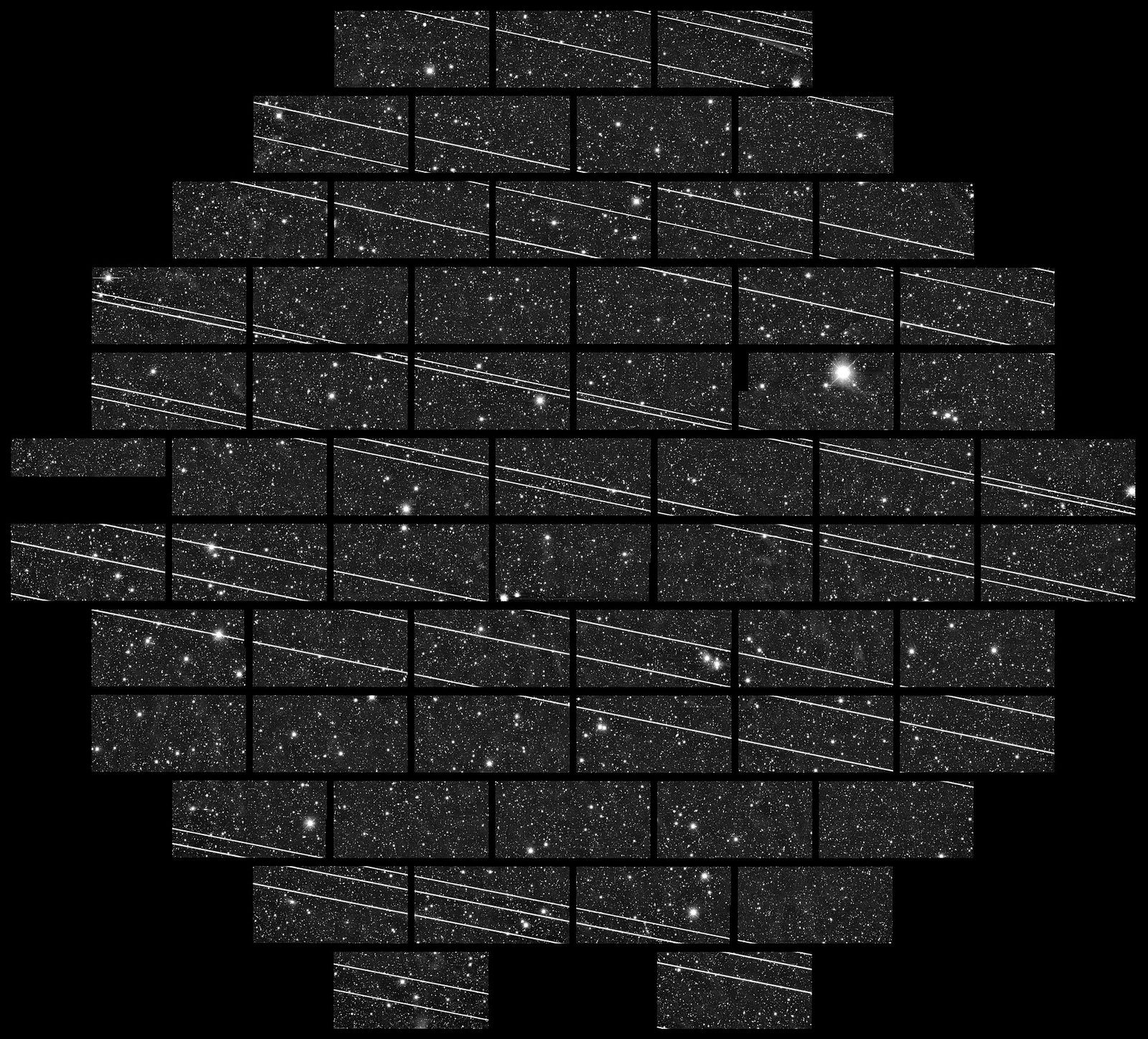
Why large satellite constellations leave streaks in telescope images, what astronomers and operators are doing about it, and what it means for anyone who simply enjoys looking up.
In May 2019, the first batch of 60 Starlink satellites was launched. Soon afterwards, people around the world reported a strange sight: a line of bright points moving across the evening sky in single file, like a train. The International Astronomical Union says the appearance surprised astronomers and the public alike, and it marked the start of a new conversation about who the night sky belongs to.
Since then, several companies have launched or announced constellations of hundreds to thousands of satellites in low Earth orbit, mostly to provide internet access. In Orbit Atlas, the dense shells of satellites close to Earth are hard to miss. This guide explains why they matter to astronomy and what is being done.
Why satellites are visible at all
Satellites shine by reflecting sunlight. Like the space station, a satellite in low orbit can be sunlit for an hour or two after sunset and before sunrise, while the ground below is already dark. Newly launched satellites are often brightest, because they fly lower in a tight group and their orientation is still being adjusted. Once they climb to their working altitude and turn to their operational attitude, most become much fainter.
Many people now see satellites on an ordinary evening without looking for them. Most are faint, but a steady procession of moving points has become part of the twilight sky in many places.
The problem for telescopes
For professional astronomy, the main concern is not what the eye can see but what sensitive cameras record. A large survey telescope takes long exposures of wide areas of sky. Any satellite that crosses the field during the exposure leaves a bright line across the image, like the streaks in the photograph above, taken in November 2019 at the Cerro Tololo Inter-American Observatory in Chile.
Rubin Observatory, which is surveying the whole southern sky repeatedly, notes that satellites brighter than about magnitude 6 to 7 can produce streaks that degrade or ruin parts of its exposures. Software can identify and mask many streaks, but the pixels underneath are lost, and very bright streaks can cause effects that spread across the detector.
Faint streaks are harder to remove and can be confused with real astronomical objects. Satellites also add a faint diffuse glow to the sky, and radio transmissions from them can interfere with radio telescopes, which depend on very quiet parts of the spectrum.
How many satellites are up there?
ESA's Space Environment Report 2025 says about 40,000 objects are now tracked by space surveillance networks, of which about 11,000 are active satellites. Constellations account for a large share of recent launches. ESA notes that around an altitude of 550 km, the number of debris objects posing a threat is now of the same order of magnitude as the number of active satellites, and that a significant part of constellation satellites now fly below 500 km.
The Orbit Atlas catalog includes only a sample of constellation satellites, so that the globe stays readable. The about page explains exactly which subset is included.
What astronomers are asking for
In April 2022, the IAU officially launched its Centre for the Protection of the Dark and Quiet Sky from Satellite Constellation Interference, known as CPS. It is co-hosted by NSF NOIRLab in the United States and the SKA Observatory in the United Kingdom. The CPS brings together astronomers, satellite operators and policy makers.
Among the recommendations developed through this work:
- Satellites in low orbit should ideally be invisible to the unaided eye. For orbits at or below 550 km, a commonly cited target is brightness no greater than magnitude 7, beyond what the eye can see from a dark site.
- Operators should share accurate, timely orbital information so observatories can schedule around satellites or predict where streaks will appear.
- Radio transmissions should avoid bands protected for radio astronomy, especially near radio observatories.
- Satellites should be designed and operated with brightness in mind, from the paint and materials to the orientation of solar panels.
What operators have done
The CPS reports that the US National Science Foundation and SpaceX signed an agreement on reducing the impact of Starlink on ground-based astronomy. SpaceX has experimented with darker coatings, sunshades and adjustments to how satellites are oriented, aiming for satellites of magnitude 7 or fainter. Other operators have engaged in similar discussions. Results vary, and independent observations by astronomers continue to measure how bright satellites actually appear.
What it means if you just like looking up
For casual stargazing, the change is noticeable but not catastrophic. You may see more moving points in the hours after sunset, particularly around midsummer at higher latitudes when satellites stay sunlit for longer. The darkest hours of the night are less affected, because most low satellites are then in Earth's shadow.
Astrophotographers taking long exposures will see more streaks in their images. Stacking software can remove many of them by comparing several exposures and rejecting pixels that only appear in one.
Looking ahead
The number of satellites in orbit is still rising quickly, and decisions about brightness, orbit altitudes and radio emissions are being made now. Low orbits also bring a debris question: more satellites mean more objects to track and more chances of collision. Our guide to space debris explains that side of the story, and where satellites go at the end of their lives covers what happens when they come back down.